 |
 |
 |
 |
 |
 |
 |
publications
A Publication of the American Pediatric Surgical Nurses Association
Summer 1992
As the Pediatric Surgical Clinical Nurse Specialist and Enterostomal Therapist a Children's Hospital of Oakland, Gail Garvin is responsible for coordinating the post-surgical care for the general surgery patients. Discharge planning, teaching, and trouble shooting nursing care problems are areas where she spends a majority of her time. Placing percutaneous intravenous peripheral and central line catheters is also a part of her clinical role. Children's Hospital of Oakland is a 200 bed hospital that supports the practice of six pediatric general surgeons. Gail's position is hospital based. She reports to the Director of Nursing. Gail received her Masters in Maternal Child Nursing at The University of California-San Francisco. As a condition of her acceptance of the Pediatric Surgery Clinical Nurse Specialist position, Gail negotiated the provision of enterostomal therapy training to enhance her qualifications. Gail felt this training would complement her pediatric medical background. She received her enterostomal therapy training and certification through Emory University ET Nursing Education Program, Atlanta, GA.
Gail serves as the wound/skin care consultant for the hospital. She follows all of her ostomy patients as outpatients on a PRN basis. She coordinates a support group which she developed for patients with bladder and cloacal extrophy.
Gail, also has been involved with the United Ostomy Association's Youth Rally for four years. The Youth Rally is for teens who have an ileostomy, colostomy, urostomy, or inflammatory bowel disease, use self-catheterization, or are incontinent of stool or urine, or have had an alternate ostomy procedure.
In her presentation before APSNA in May, 1992 entitled "Dealing with Problem Stomas," Gail shared her expertise in ostomy, wound, and skin care for children. Gail has also authored many articles on pediatric ostomy care including: "Discharge Preparation of the Pediatric Patient with an Ostomy", in Progressions 1990 vol 2 #2, "Wound Healing in Pediatrics" in Nursing Clinics of North America March 1990 vol 25 #1 pp 181-192, and "Skin care considerations in the neonate for the ET nurse" in Journal Of Enterostomal Therapy 1990 17 pp 225-30.
Gail was instrumental in the formation of APSNA. Through her cross continental collaboration with Diane Jakobowski, thc current President of APSNA from Children's Hospital of Philadelphia, the idea to form a national network of pediatric surgical nurse specialists developed. In 1991, Gail chaired the organizational subcommittee. This year, she was unanimously elected to the position of President-Elect.
Gail Garvin, RN, MS, CETN has been the Pediatric Surgical Clinical Nurse Specialist and Enterostomal Therapist at Children's Hospital of Oakland, Oakland, California for Six years.
The literature states that for a period of time after pullthrough procedures nearly all patients will experience some perianal skin irritation. Denise Taylor, RN, CNSN, of Children's Hospital of Oklahoma, more accurately describes this condition as "Diaper Rash from Hell!" This condition was discussed at the "Nurse's Day" of the 1992 APSA Meeting. Several suggestions are presented for prevention and treatment.
Commercially Available Products
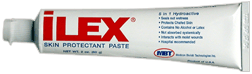
ILEX skin protectant paste is available from MEDCON
This paste will stick to very weepy denuded skin. It also will stick to the diaper so you must cover the ilex with a coating of Vaseline or zine oxide to keep it from sticking to the diaper. Instruct the parents to only wipe off the zinc oxide or Vaseline with each stool then reapply it over the remaining ilex. Only reapply more ilex if you can see the skin showing through. Have the parent clean all the products off once a day with the bath to inspect the skin. Most skin problems are 50% better by the next day, and heal in 3-7 days.
For more information or to order ILEX, please call MEDCON l-800-443-6332.
The Journal for Prevention and Healing
Vol. 8 #4 July/August 1995
Evaluation of Moisture
Penetration Through Skin
Protectant Barriers by Paper
Chromatography
Sadiq Shah, Marc Cornell, and Anthony J. Ward
Figures:
Abstract
Currently, there is no convenient and safe experimental method in the literature to evaluate skin protectant formulations for barrier properties. A novel and simple experimental method, based on paper chromatography, was developed to screen a broad spectrum of skin protectants available for moisture penetration. The method involves the use of paper chromatography for determining the Moisture Penetration Rate through a thin barrier film of a given skin protectant product It is simple, inexpensive, convenient, and safe and was used to evaluate 12 products currently used as skin protectants. This method can be used by formulators in their development efforts and by caregivers to determine the barrier properties of various products in a short period of time without expensive instrumentation or extensive time commitments.
Skin irritation resulting from fecal and urinary incontinence is a common problem for geriatric patients (Fiers & Siebert, 1993; Talbot, 1994). Various products on the market today are used as protective barriers to prevent skin irritation from moisture penetration. However, from the caregivers perspective, there is a need for identifying the best product or the relative ranking of products based on suitable test methods. There is a lack of suitable in vitro test methods to screen skin protectant barriers (Guillemin,Mulset, Lob, & Riquez, 1974; Pigatto, Bigaldi, Legori, Altomare, & Finzi, 1993) on the market For any method to be acceptable it must be convenient, simple, reproducible, and safe for use on human volunteers. More importantly, it must have clinical relevance.
Literature suggests the use of three methods to evaluate skin protectants. One of these methods relies on the extraction of the dye from the stratum corneum and determination of the concentration by spectrophotometry (Marks, Dykes, & Hamami, 1989; Trefel, Gabard, & Juch, 1994). Another method relies on the irritation caused to the skin and subsequent effects on bloodflow rates in the irritated areas as measured by Laser-Doppler method (Nilson, Otto, & Wahlberg, 1982; Wahlberg, 1984). The third method focuses on the histological examination of skin samples (Mahmoud, Lachapelle, & Neste, 1984).
All of these methods have their strengths and limitations. The dye method is dependent on the hydrophobicity and hydrophilicity of the dye and its compatibility with the hydrophobicity and hydrophilicity of the skin protectant as well as that of the skin. It also is dependent on quantitative recovery of the dye from the skin matrix for final evaluation. Use of the skin irritation test depends upon the availability of human volunteers or animals for testing. The histological approach depends upon multi-step sample preparation before any examination can be conducted. Furthermore, from the standpoint of product development, there is no suitable and convenient method in the literature to evaluate skin protectants for moisture penetration. This paper describes a simple, convenient, reproducible, and safe method for evaluation of skin protectants for moisture penetration
Methods and Materials
The experimental setup involved the use of a circular Watman #4 filter paper with a hole (about 2 mm radius) in the center. (See
This entire unit was then placed in a cup containing water. The lower end of the wick was immersed in the water, allowing water propagation vertically along the length of the wick and then radially on the filter paper through the thin protective product film. (See
This study evaluated the following products: Triple Care® (Smith & Nephew United, Inc.), Baza (Sween Corp.), Soothe & Cool (Medline Industries, Inc.), Lantaseptic® (Summit Industries), Daily Care (Pfizer), Petrolatum (Witco), Desenex® Ointment and Cream (Fisons), Proshield (HealthPoint Medical), Micatin® (Ortho Pharmaceuticals), Carrington Antifungal (Carrington), and iLEX® (Calgon Vestal Laboratories).
Results and Discussion
The MPR results for various products are shown graphically in
This method also easily distinguishes between various formulation bases such as creams and ointments. In general, ointments (based on more than 15% petrolatum) will rank better than creams that are emulsions and contain less than 15% petrolatum. Typically, oil-in-water emulsions will tend to facilitate the penetration of moisture through the continuous aqueous phase. Water in the continuous phase will quickly spread through the filter paper upon contact of the wick with the body of the filter paper. In this test, creams based on water-in-oil emulsions will rank better than oil-in-water emulsions because water is the internal phase. Some products that are good barriers but contain a high concentration of mineral oil will exhibit the spreading of the oil through the filter paper. However, the oil-insoluble ink will not exhibit any spreading with the oil front, thereby reflecting the good barrier properties. Various parameters will affect the final MPR results and, for a given study, will have to be kept constant so that the results of relative ranking will hold. These parameters are filter paper brand and type, and brand of marker used. It is therefore recommended that for relative ranking of various products, it is highly desirable to use the same brand and type of the filter paper and the markers.
Conclusions
Based on the broad spectrum of products and the control samples evaluated, it appears that this method is simple, easy to use, inexpensive, and very sensitive in differentiating the skin protectants. Additional work will be needed to establish the clinical significance of the ranking determined by this method. Among, the products evaluated, only iLEX® was able to exhibit an MPR of 0.00 0.00 cm/hr. This property is based on the fact that the formulation contains a polymer that is hydroactive. As soon as the thin film of iLEX® encounters moisture, the moisture barrier property is activated. On the other hand, the fastest MPR was observed for the neat petrolatum. This is believed to be a consequence of petrolatum's somewhat porous internal structure. This porous structure allows for communication channels for moisture penetration.
| about iLEX® | publications | case studies | testimonials | client list | psoriasis | online ordering |
iLEX® is a registered trademark of Medcon Biolab Technologies, Inc.